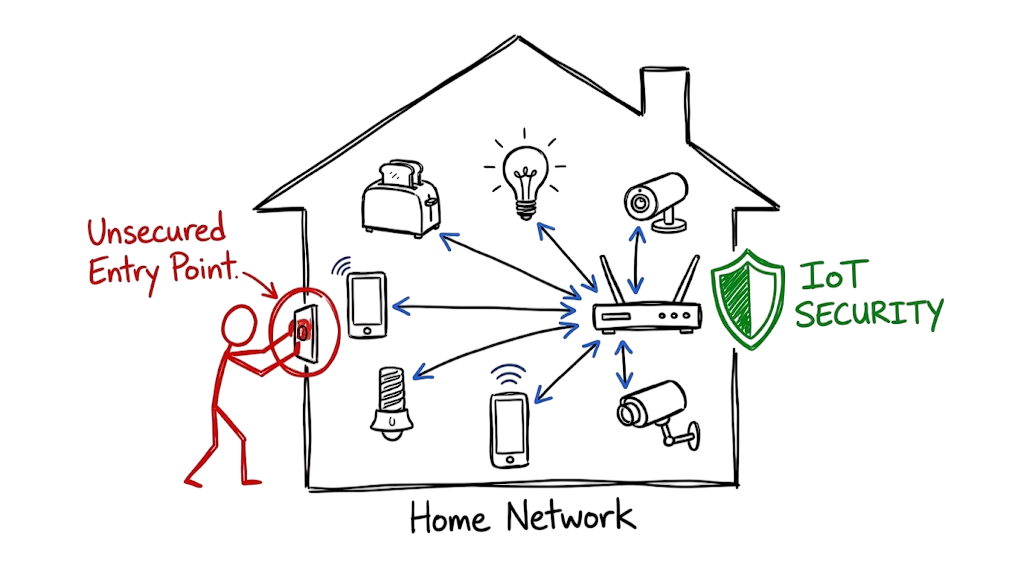
Indeed, it has happened that IoT technology has found itself inside of almost every house’s room now. From smart toasters to door locks or light bulbs – each of these gadgets is a computing device. Although the use of these items can bring more ease and productivity to us, every one of them provides another entry point for potential hackers to our home’s private network. So, unless you guard every of your entry points, an attacker can gain access into other devices within your network or take your personal data.
Usually, a regular user thinks about protecting only their laptop and smartphone, which are the most expensive and valuable assets. Such things as antivirus program usage, OS updates or creation of strong passwords can be performed only by people who realize the significance of this issue. Nevertheless, they forget about other devices that might be found inside their house: smart plugs, security cameras or video doorbells. Such negligence can create a vulnerability that will help hackers to get into their system.
Knowing about IoT security has become a must in the modern world already. Today, such a topic concerns everybody since it applies not only to IT specialists but regular users. Based on predictions, by 2026, more than 75 billion devices will be connected to the internet. Moreover, the numbers will rise year by year due to increasing popularity of smart houses, wearables and IoT industries. Nevertheless, practices concerning IoT security still remain behind this rate of growth.
Manufacturers of IoT devices often do not pay sufficient attention to security measures. Mostly, products go out under-protection and/or untested. This situation leads to problems that happen in real life to such gadgets, as they enter their market environment in default configuration. Some of them have pre-defined usernames and passwords, others cannot be updated and the third ones transmit data in plain-text format without any additional protection measures.
In this post, you will discover several issues that you might face in future and possible solutions to this problem. You will understand the reasons for particular behavior of IoT gadgets and why they have specific security properties. For example, they have low computation capabilities, lack security features and permanent internet connection. Such a combination of traits creates an attractive environment for criminals’ actions.
Furthermore, I will give you several examples of attacks that occurred in the last few years. In some cases, hacked IoT devices were used to build botnets that conducted DDoS attacks. Also, there are stories when security cameras were used to get access and spy the activity of homeowners. Such events occur very frequently. They happen only because some simple steps are skipped while setting up an IoT gadget.
In my experience, the easiest gadgets become sources of biggest disasters. We ignore them because we feel that they are not dangerous enough on their own. But we need to realize that connecting such things to our network turns them into potential risks. Since they can be unprotected, they will allow attackers to get into the whole network.
The Massive Scale of Our Connected World
The term “internet of things” (IoT) refers to any item that connects to the internet in order to exchange information or data. Examples include smartphones, tablets, smartwatches, baby monitoring devices, and even specialized gadgets used in factories, power plants, and other enterprises. By 2025, it was estimated that about 21 billion IoT devices existed. As more and more consumers continue to use smart products at home or at work, the number of devices will only increase.

With more and more connected items available, the size of the attack surface grows. Each added device represents one more point of vulnerability. Unlike ordinary hardware, most IoT products lack sufficient security measures since they are intended to execute basic functions and require little computing power. In other words, they are unable to support antivirus protection or comprehensive endpoint security solutions.
Moreover, most devices work as edge devices. This implies that instead of being a part of a corporate system and being under its direct control, they operate separately. They connect to the system via routers and can easily communicate with cloud services and mobile applications. Due to their constant power supply and connection, IoT devices are always available to an attacker.
Often, owners do not realize the potential dangers that come with using IoT devices. The reason is simple – these are usually very simple pieces of hardware. Who would consider a lamp or a plug vulnerable? Nevertheless, hackers do not assess the importance of a gadget. They are primarily interested in its weaknesses. And most IoT gadgets do lack strong security.
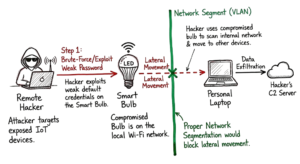
Having infiltrated one piece of equipment, a hacker can move laterally. For instance, using an infiltrated smart bulb, he or she could conduct a scan of other connected devices to find further opportunities to access them. If you use your phone, laptop, or other gadgets in combination with your work station on the same network, then they could become targets for an attack.
Common Cybersecurity Risks in Connected Devices
Hackers look for the easiest path. IoT gadgets are usually the weakest link. Here are the most common cybersecurity risks found in modern hardware.
1. Default and Weak Passwords
Many devices ship with a standard password like “admin” or “12345.” Most users never change these settings. Hackers use automated scripts to try thousands of default logins in seconds. If you leave the factory password active, your device is essentially open to the public. In real environments, this is the most frequent way hackers gain a foothold.
2. Lack of Secure Updates
Your laptop gets regular updates to fix security holes. Many cheap IoT devices do not. Some manufacturers do not even provide a way to update the software. These IoT vulnerabilities stay open forever. This gives attackers a permanent way in. If a device cannot be updated, it is a ticking clock.
3. Insecure Data Transmission
Devices often send your personal data over the air. If this data is not encrypted, anyone on the same Wi-Fi can read it. This could include your voice recordings, your location, or even your bank details. We call this a man in the middle attack. It happens because the device is too weak to handle complex encryption.
4. Poor Physical Security
If an attacker can touch your device, they can often own it. Many smart locks or outdoor cameras have exposed ports. A hacker can plug in a small tool and take control of the system in minutes. I have seen cases where a simple USB drive was all it took to bypass a smart lock.
5. Hidden Backdoors
Sometimes developers leave backdoors in the code for testing. If they forget to remove these, hackers find them. This allows an intruder to bypass your login screen entirely. These are hard to find because they are buried deep in the software.
6. Insecure Web Interfaces
Many devices let you control them through a website. If that website is poorly coded, an attacker can use injection attacks. This lets them send bad commands to your device through your browser. They might tell your camera to turn off or your heater to turn up.
7. Shadow IoT
In offices, employees often bring in their own gadgets. A smart coffee machine or a fitness tracker might connect to the company Wi-Fi. If the IT team does not know it is there, they cannot protect it. This is a blind spot for modern businesses. I once saw a whole warehouse network go down because a single smart thermometer was unpatched.
Real-World Scenario: The BadBox 2.0 Incident
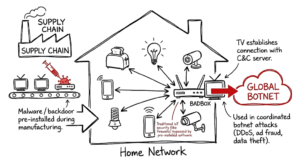
In 2025, security researchers discovered a massive problem called BadBox 2.0. Malware was pre-installed on over 10 million smart TVs and projectors before they even left the factory. These devices were sold through major online retailers.
Once users connected them to the internet, the TVs became part of a global botnet. A botnet is a network of hijacked computers used to attack other websites. The owners had no idea their new TVs were helping criminals. This case shows that even buying a brand new device carries a risk if the supply chain is not secure. This is why we tell juniors to segment everything.
The Physical Risks of Unsecured IoT Devices
When a laptop gets hacked, you might lose your files. When an IoT device gets hacked, the results can be physical. This is why IoT security is vital.
Threats to Home Privacy
Hackers have been caught spying on families through baby monitors and security cameras. They can watch your daily routine to know when you are not home. This turns a safety tool into a burglary aid. It is a direct invasion of your private space.
Risks to Human Health
In the healthcare sector, we use the Internet of Medical Things (IoMT). This includes heart monitors and insulin pumps. A breach here is not just about data. If an attacker changes the settings on a medical device, it could be fatal. Recent data shows that a single healthcare breach can cost over $10 million in damages.
Critical Infrastructure Attacks
Factories and power plants use sensors to manage their systems. If a hacker takes over these sensors, they can shut down the power grid or poison a water supply. This makes connected hardware a matter of national security. We saw this with the Stuxnet incident years ago. Sensors are the eyes and ears of our power plants.
Global Standards for IoT Security
Governments are finally starting to fight back. New laws are making it harder for companies to sell insecure junk.
- U.S. Cyber Trust Mark: The FCC recently launched this voluntary label. It helps you see which products meet high safety standards. Look for a shield logo on the box when you shop.
- UK PSTI Act: The United Kingdom now bans default passwords by law. Manufacturers must also tell you exactly how long they will provide security updates. This adds accountability.
- EU Cyber Resilience Act: This law requires companies to report any hacks within 24 hours. It also mandates that security be built into the product design from the start.
How You Can Improve Your IoT Security Today
You do not need to be a coder to protect your home. Follow these simple steps to lock down your connected devices.

Change Your Passwords Immediately
The moment you take a device out of the box, give it a unique password. Use a mix of letters, numbers, and symbols. Never use the same password for two different gadgets. This prevents a hacker from gaining total control if they get one password.
Enable Multi-Factor Authentication (MFA)
Many apps now offer MFA. This sends a code to your phone when you try to log in. It adds a vital layer of protection. Even if a hacker has your password, they still cannot get in without that second code. I never set up a device without this enabled.
Set Up a Guest Network
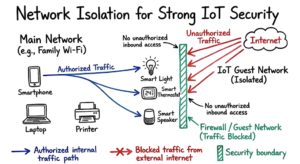
Most modern routers let you create a second Wi-Fi network. Put all your smart home gadgets on this Guest network. Keep your main computer and phone on your private network. If a smart bulb gets hacked, the intruder cannot reach your sensitive files. This is the best way to isolate risks.
Turn Off Universal Plug and Play (UPnP)
UPnP helps devices find each other easily. It also helps hackers find your devices from the internet. Go into your router settings and turn this feature off. You may have to connect things manually, but it is much safer.
Check for Updates Once a Month
Open the app for each smart device and check for firmware updates. These updates often contain security patches for new cyberattacks. If a device has not been updated in over a year, it might be time to replace it. An old device is an open door.
Conclusion
The advantages of living connected are convenience and savings on power expenses. However, the risks associated with cybersecurity should not be underestimated. Both IoT device producers and consumers share the responsibility of securing their gadgets.
A few basic precautions can help you enjoy using technology without fear. Ask questions, learn daily, and change the preset login information. The key to cybersecurity lies in the smallest details.
Reference: wikipedia
For more detailed IoT tutorials and real-world examples, check iot.technaga.com