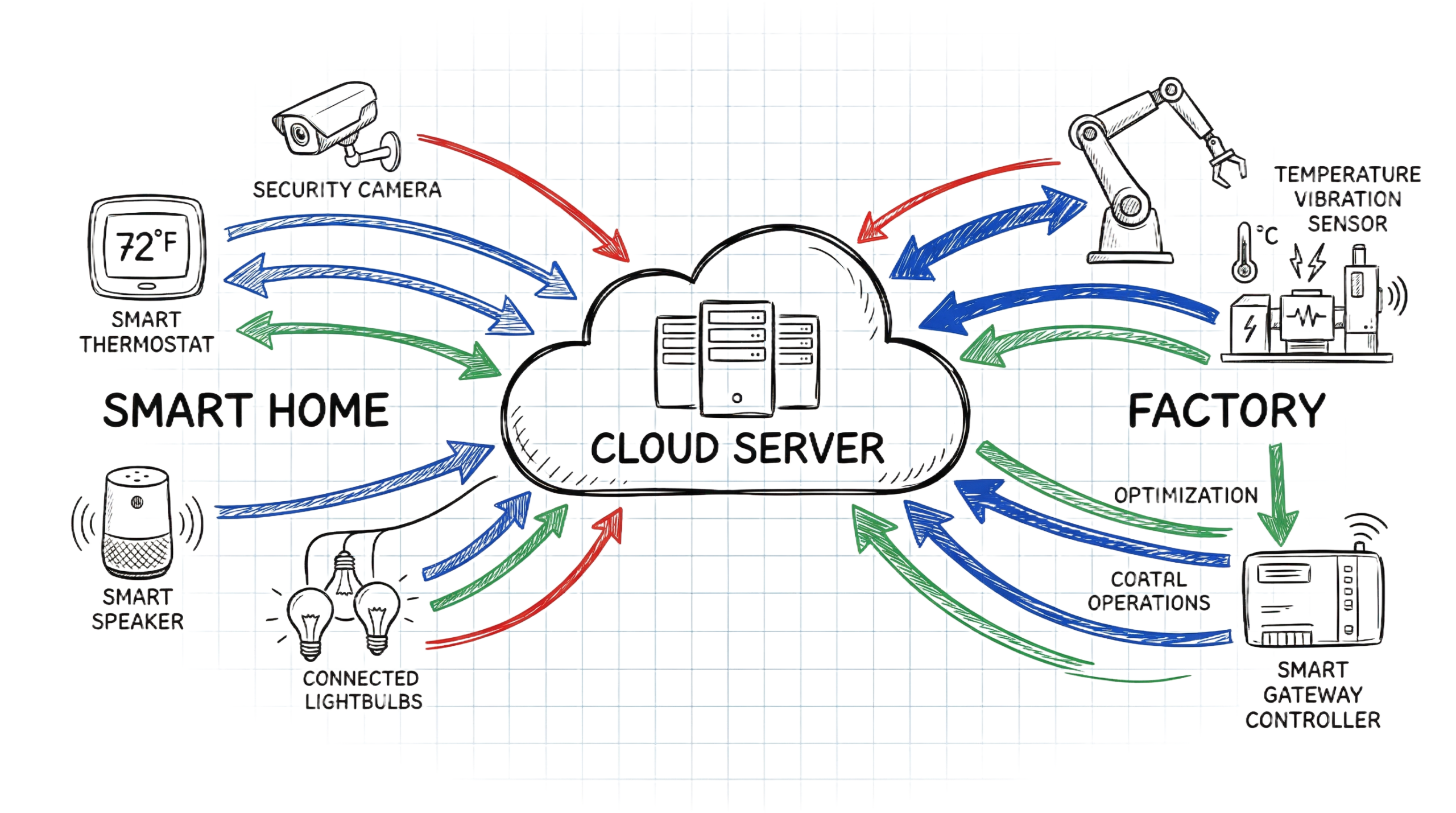
IoT Protocols help in establishing interaction between devices within a network. According to predictions, the number of connected devices will grow to 31.2 billion by 2030, compared to 19.8 billion in 2025. With this rapid growth, you need to pay attention to how devices communicate.
Every IoT device uses a specific communication protocol to send and receive data. This directly affects data speed, reliability, and power consumption.
First of all, it is necessary to note that an IoT protocol contains detailed data regarding the format and procedure of communication between a device and other devices, services or applications using this protocol. In order to send data received by a device from a particular sensor, a certain protocol should be applied to provide information to a cloud service or application. Hence, an IoT protocol contains information regarding how data should be transferred and confirm the successful data reception.
Since various applications have distinct features, different protocols are used to interact with various IoT devices. Some examples include protocols like MQTT and CoAP used in home automation and monitoring systems, respectively. However, when it comes to data exchange via the Internet, HTTPS/HTTP is the best option but at the same time consumes much energy. Among enterprise-oriented protocols, AMQP is the most popular because of the security and messaging.
There are several aspects to consider while choosing a particular IoT protocol. Firstly, it is essential to define whether devices use strong or weak power source. Secondly, a person should take into consideration how often devices communicate with each other. Thirdly, it is necessary to consider what type and volume of information devices exchange during communication. After considering the parameters mentioned above, it is possible to pick a good protocol specification.
While implementing a particular IoT protocol in practice, it is important to pay attention to its performance. For instance, a protocol with complicated algorithms may degrade performance of devices or consume much power. Hence, switching from an HTTP protocol to the MQTT protocol helped my friend to save energy because of event-based data transmission instead of requests.
As can be seen from the information presented above, an IoT protocol plays a critical role in the efficiency, scalability, and stability of IoT systems. That is why it is necessary to conduct preliminary research concerning protocol specifications to avoid potential problems with IoT communication. Thus, analyzing various IoT protocol types and specifications helps to determine the most appropriate solution.
What Are IoT Protocols?
A protocol is a language in which two devices communicate with one another. As long as they share the same protocol, devices can transmit information back and forth without errors and inconsistencies. Traditional computer devices depend on a TCP/IP stack, and it serves them well when laptops and powerful servers are used for data transmission. Such devices have sufficient resources and power, as well as sufficient memory and processing capacity to support many levels of communication.

However, modern Internet of Things gadgets cannot boast such technical characteristics, as they have less memory and need to consume much less power. IoT devices are usually small and battery-operated; their memory does not exceed several kilobytes. Moreover, a device can work for long periods of time without recharging. Under such circumstances, using conventional web protocols seems ineffective since HTTP consumes additional bandwidth, takes much time and increases the load of the system and power consumption of it.
There are protocols specifically created for IoT. They are lightweight, which means that they use smaller data packets, as well as simpler communication techniques. Therefore, lightweight protocols decrease power consumption and make gadgets work faster. They also take into account unstable network environments, since IoT gadgets can be located remotely and use networks with lower power. In such a case, connection may be lost quite frequently, but lightweight protocols are prepared for this situation and can maintain proper operation under such conditions.
One of the main mistakes related to Internet of Things protocols is a usage of any other protocol than a suitable lightweight one. HTTP protocol, for example, is appropriate only for web applications and APIs and is unsuitable for IoT devices because of increased power consumption. Using inappropriate protocols leads to poor results and decreased performance.
In order to choose a good protocol, it is necessary to know specific characteristics of a particular gadget. First of all, you should find out whether your device is battery-operated and if it transmits large amounts of data or not. If it is true, then lightweight protocol should be chosen. Otherwise, any protocol can be applied.
Popular IoT Protocols for Messaging
Messaging protocols handle the data exchange between your device and the server. They sit at the top of the technical stack. Your choice here directly affects how your application performs in real time.
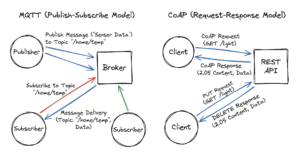
MQTT: The Lightweight Standard
MQTT stands for Message Queuing Telemetry Transport. It is the most common choice for developers right now. It uses a system called publish and subscribe. A central broker manages all the messages. One device publishes data to a topic. Other devices subscribe to that topic to receive the update.
This protocol is highly efficient. It works well on bad networks. You can use it for smart home devices like light bulbs or thermostats. It keeps the connection open with very little overhead. The OASIS standard 3.1.1 is the most widely used version for these tasks.
CoAP: The Web Protocol for Sensors
CoAP is the Constrained Application Protocol. The IETF defined this in RFC 7252. It is similar to HTTP. But CoAP uses UDP instead of TCP. That makes it much faster for small devices.
CoAP is a RESTful protocol. It uses commands like GET and POST. It is a great choice if you want your devices to interact with web services easily. It supports multicast. That allows one message to reach multiple devices at once. You should use CoAP when you need low latency and simple web integration.
DDS: Real-Time Data Sharing
The Data Distribution Service is for high performance systems. It does not use a central broker. Devices talk to each other directly. This cuts down the time it takes for a message to arrive. You will find DDS in autonomous cars and industrial robotics. It ensures that data arrives exactly when the system needs it.
Understanding IoT Protocols for Long-Range Use
Sometimes your devices sit far away from a power source. You might have sensors in a large farm or spread across a city. In these cases, you need IoT protocols that cover long distances with low power.
LPWAN: Connecting Over Miles
LPWAN stands for Low Power Wide Area Network. These networks send data over several miles. They use very little energy. A sensor using LPWAN can often run on a single battery for ten years. Now here’s where it gets interesting. You have a few distinct options:
- LoRaWAN: This uses unlicensed radio frequencies. You can build your own private network with a gateway. It is perfect for rural areas where cellular signals are weak.
- Sigfox: This is a subscription based service. It sends very small amounts of data. It is ideal for simple tracking or basic alarms.
- NB-IoT: This stands for Narrowband IoT. It uses existing cellular towers. It provides excellent coverage inside buildings and underground.
5G RedCap: The New Middle Ground
5G RedCap is a newer standard. It stands for Reduced Capacity. It is designed for devices that need more speed than NB-IoT but less power than a smartphone. RedCap uses 70 percent less power than standard 5G. You can use this for industrial cameras or high end wearables. It provides a reliable connection for devices that move around frequently.
Managing Your Smart Devices
Connectivity is only the first step. You also need to manage your hardware. This includes updating software and checking battery levels.
LwM2M for Device Management
Lightweight M2M is a protocol for remote management. The Open Mobile Alliance built it. It runs on top of CoAP. You can use LwM2M to configure thousands of devices at once. It handles security and service discovery automatically. If you run a large fleet of sensors, this protocol is essential for maintenance. In real environments, it doesn’t work this cleanly if you skip the initial provisioning steps. You have to set up your keys right the first time.
The Matter Standard
Matter is a newer application layer protocol. It focuses on the smart home. It allows devices from different brands to work together. If a device has the Matter logo, it can talk to your Amazon Alexa or Apple HomeKit. Matter runs on top of Wi-Fi and Thread. It uses a technology called a Matter fabric to keep your home network secure.
A Real-World Scenario: Smart Agriculture
Recently, we discussed an implementation of an irrigation system in one California vineyard that uses a smart network based on IoT protocols. It includes approximately 500 sensors that measure the soil moisture throughout all vineyards. They use LoRaWAN protocol to transfer data about current moisture level and its changes to a central gateway that is positioned almost two miles away from them. The nature of this protocol is such that it requires low power and supports a long distance, so sensors have to transfer tiny data packets, thus, running without battery replacement for many years.
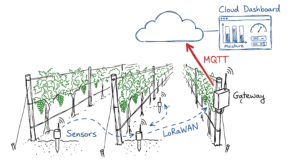
However, after passing through the gate, collected data does not stop there. In this stage, it gets transferred using MQTT protocol to a cloud-based dashboard. Its features are convenient for this step because it is quite lightweight and has support of publishing/subscribing, so the dashboard receives the information only when it needs it.
So, we get a very effective data exchange process, since each protocol used performs the task it was made for. It means that we do not make a LoRaWAN work in the way that it was not designed, nor MQTT is overloaded by transferring huge amounts of data.
As a result, we can talk about tangible improvement of a certain system. In the case of this vineyard, they could save about 20 percent of water during each season, so it had an effect on their expenses.
Security Considerations for IoT
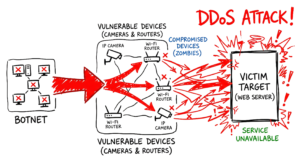
Security is a massive concern for all connected systems. In 2023, variants of the Mirai botnet targeted over 300,000 devices. We saw this issue firsthand in a recent audit. These attacks often succeed because engineers leave default passwords or use weak protocols. You must use encryption to protect your data.
Most IoT protocols support security layers. For example, CoAP uses DTLS to encrypt messages. MQTT uses TLS for the exact same purpose. You should also require strict device authentication. This ensures only trusted hardware joins your network. Always disable features you do not actually use to reduce your attack surface.
Choosing the Right IoT Protocols
Selecting the best protocol depends entirely on your project goals. If you are building a smart home app, MQTT or Matter are your best choices. For long range tracking, you should look at LoRaWAN or NB-IoT. If you need high speed data for a factory floor, DDS or 5G RedCap will serve you best.
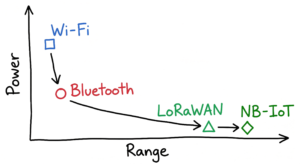
You have to balance three main factors: power, range, and data speed. You rarely get all three at the highest level. A device with a long range and high speed will drain its battery fast. A low power device will usually have a slower data rate. Understanding these physical limits will make or break your project.
The rules around IoT protocols change frequently. New standards like Matter 1.4 now support energy devices like EV chargers. Staying updated on these specs helps you build more secure technology. Start with a simple protocol like MQTT for your very first project. As you learn the ropes, you can test specialized standards for your specific needs.
Reference: wikipedia
For more IoT Protocols and IoT blogs, visit iot.technaga.com and explore detailed guides.